

Quick Navigation:
If you're shopping for your first Japanese knife, you've likely narrowed it down to two options: the santoku knife and the gyuto knife. Both are excellent multipurpose knives with some key differences in size, design, and handling characteristics.
The short answer: Choose a gyuto knife if you want maximum versatility and have space for a longer blade. Choose a santoku knife if you want compact convenience with a flat profile.
This guide will walk you through the key differences between these two popular Japanese multipurpose knives, helping you make the right choice for your kitchen. For a broader overview including steel types, finishes, handles, and price ranges, see our guide to choosing your first Japanese knife.
Understanding the Gyuto Knife: Japan's Version of the Chef's Knife

The gyuto knife is essentially Japan's version of the Western chef's knife. The name translates to "cow sword," reflecting its original purpose for cutting meat. Today's gyuto has evolved into a versatile Japanese chef knife that handles almost any kitchen task.
Key Characteristics of Gyuto Knives:
- Blade length: Typically 210mm (8.2") to 270mm (10.6")
- Profile: Flat heel section with slight curve/belly toward the tip
- Tip: Pointed tip for precision work
What Makes Gyuto Knives Excel:
The longer blade lets you complete cuts in one motion. Slicing large vegetables like cabbage, portioning boneless meats, or cutting fish fillets all benefit from the extra length. The pointed tip is better for tip work.
Understanding the Santoku Knife: The Three-Virtue Blade

The santoku knife is a more recent addition to Japanese knife design, developed in the mid-20th century specifically for home kitchens. The name means "three virtues," with two interpretations: some sources refer to the three cutting techniques of chopping, slicing, and dicing, while others interpret it as the knife's ability to handle meat, fish, and vegetables.
Key Characteristics of Santoku Knives:
- Blade length: Usually 165mm (6.5") to 180mm (7")
- Profile: Relatively flat profile with very minimal curve toward the tip
- Tip: Sheep's foot tip design
- Heel height: Taller than gyuto knives of the same blade length (e.g., 180mm santoku vs 180mm gyuto)
What Makes Santoku Knives Excel:
The santoku's compact size makes it highly maneuverable, especially in smaller kitchens or when working with limited counter space. The relatively flat blade profile makes it ideal for push-cutting techniques.
Santoku Length Advantages:
The santoku's shorter blade is easier to control and maneuver in tight spaces. In smaller kitchens where counter space is precious, you need less room to work safely, and the shorter blade reduces the risk of accidentally hitting walls or other objects during use.
Quick Comparison
| Feature | Gyuto | Santoku |
|---|---|---|
| Length | 210mm-270mm (8.2"-10.6") | 165mm-180mm (6.5"-7") |
| Blade Profile | Flat heel section with slight curve toward tip | Relatively flat with minimal curve |
| Tip Profile | Pointed | Sheep's foot |
| Best For | Maximum cutting efficiency | Compact convenience, smaller kitchens |
Three Key Differences to Consider
1. Blade Length
Gyuto knives typically range from 210mm to 270mm, while santoku knives usually measure 165mm to 180mm. Both knives handle vegetables, proteins, and general kitchen tasks equally well - the gyuto just offers more blade length and can double as a slicer for larger ingredients.
2. Heel Height and Knuckle Clearance
For gyuto and santoku knives with the same blade length, the santoku will almost always be taller at the heel. For example, a 180mm santoku typically has more height than a 180mm gyuto, giving you more knuckle clearance. Both provide good clearance, but santoku offers a bit more for those who prefer keeping their knuckles higher.
3. Tip Design
The gyuto's pointed tip is better for tip work. The santoku has a sheep's foot profile which isn't as effective for these tasks. But if you want the compactness of a santoku with a more pointed tip, consider a bunka.
Steel Type and Construction
Both santoku and gyuto knives come in two main steel types. Your choice depends on how much maintenance you're willing to do.
Stainless Steel: Rust-resistant and easy to maintain. Popular options include VG10, SG2, and Ginsan.
Carbon Steel: Requires more care (clean and dry immediately after use), develops patina over time. Popular options include Shirogami#2, Aogami#2, and Aogami Super.
Construction Types:
- Monosteel: Single piece of steel - can be stainless or carbon throughout.
-
Laminated blades: Core steel sandwiched between two layers which can be either stainless or soft iron
- Stainless-clad carbon: Carbon core with stainless steel cladding for easier maintenance than monosteel carbon or iron-clad blades
- Iron-clad carbon: Carbon core with iron cladding - entire blade is reactive.
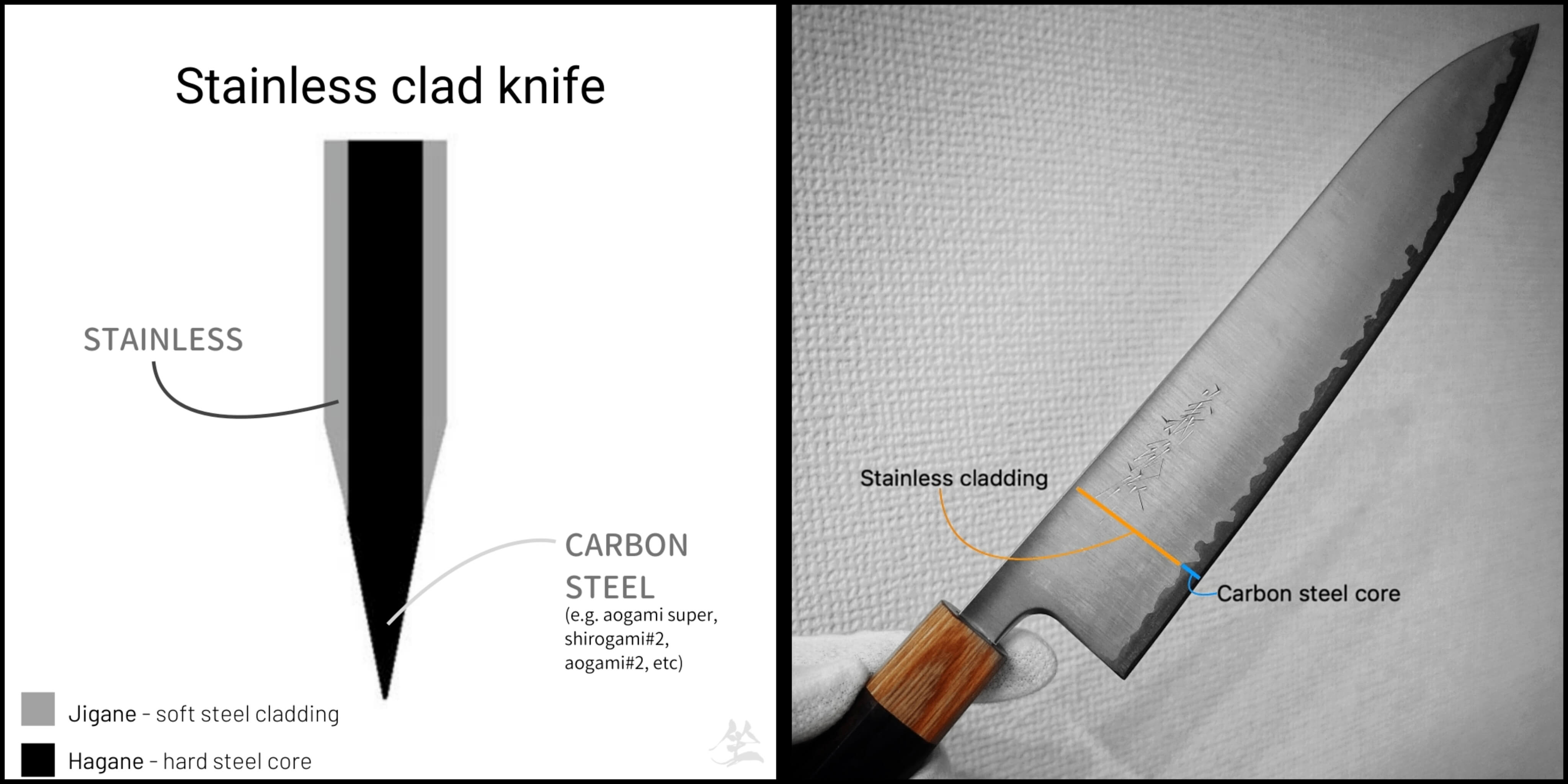
Which to choose: Want easy maintenance? Go with stainless steel. Okay with more care? Choose carbon steel. Stainless-clad carbon offers a middle ground. For more details, see our steel guide.
What About a Bunka?

Before deciding between santoku and gyuto, consider the bunka knife - if you want a short, compact multipurpose knife but with a more nimble and versatile tip.
The bunka maintains the santoku's compact length (usually 165mm-180mm) and high heel height for excellent knuckle clearance, but features a reverse tanto tip instead of the sheep's foot tip. This angled tip provides much better precision and dexterity than a santoku.
Bunka Advantages:
- More versatile and nimbler tip compared to a santoku
- Distinctive angular appearance
- Tend to have a much flatter profile (depends on the brand) compared to santoku, ideal for push-cutting techniques
Bunka Considerations:
- Requires learning proper push-cutting technique if you're new to flat blade profiles
- The angled tip can be delicate and requires careful handling
Price Considerations
Japanese knives range from under $50 to over $500.
Entry-Level ($50-$200): High-quality knives from brands like Masahiro, Takamura VG10, Tsunehisa, and Hatsukokoro. These offer excellent performance for daily cooking. Check out our Essential Series.
Mid-Range ($200-$500): Refined craftsmanship from makers like Yu Kurosaki, Anryu, and Yoshikane. Better fit and finish with thinner geometry. See our Enthusiast Selection.
Premium ($500+): Knives from renowned master craftsmen with limited production. Includes specialty pieces like honyaki. Best for collectors and enthusiasts. Browse our Collector's Selection.
If you're just starting out, entry-level options offer the best value. As you develop your preferences, you can explore higher tiers.
Maintenance and Care
Both santoku and gyuto knives require the same care:
- Sharpening: Use Japanese whetstones. Start with a medium stone (#800-#1000) for general sharpening.
- Daily care: Hand wash and dry immediately after use, regardless of steel type.
- Usage: Never cut through bones or hard materials. Use wooden cutting boards. Avoid twisting or prying motions.
For detailed maintenance guidance, see our Japanese knife care guide.
Which Knife Should You Buy First?
The decision ultimately depends on your kitchen setup and personal preferences.
Choose a Gyuto Knife If:
- You want to handle more kitchen tasks effectively in a single knife
- You want a longer blade for efficient prep work
- You have adequate counter space
- You frequently need the precision of a pointed tip
Choose a Santoku Knife If:
- You want a compact versatile knife with a flat profile
- You have limited kitchen space
- You find longer knives intimidating or unwieldy
Making Your Final Decision
Start by considering what knife you've been using previously. Do you think it's perfect for your needs? Is it too long and you prefer something shorter? Or do you find yourself wanting a longer blade for more efficient cutting?
Consider your kitchen setup as well - smaller kitchens often work better with santoku knives, while larger cooking spaces can accommodate gyuto knives more easily.
Remember that either choice will significantly upgrade your cooking experience. Both santoku and gyuto knives can handle the vast majority of home cooking tasks effectively.
Key Takeaways
The santoku vs gyuto decision comes down to your specific preferences rather than one being universally better than the other. The gyuto handles more kitchen tasks effectively and excels with its longer blade and pointed tip. The santoku is all about compactness with a bit more knuckle clearance when comparing same-length knives.
Either knife will serve as an excellent introduction to Japanese cutlery. Choose based on your kitchen space and cooking style - you can't go wrong with either option at any price tier.
Ready to start your Japanese knife journey? Browse our Essential Series or explore our full collection to find the perfect gyuto or santoku for your kitchen.
Whichever knife you choose, invest time in learning proper technique and maintenance. A well-maintained santoku or gyuto knife will transform your cooking experience and serve you well for many years.
About the author: Fred M. trained at Tokyo Sushi Academy and worked as a sushi chef before starting Zahocho Knives in 2019. Based in Japan, he sources knives from renowned knife-making regions like Sakai and Sanjo, working with blacksmiths like Yoshikazu Tanaka, Satoshi Nakagawa, and Kisuke Manaka.